














-
Interconnect and Network Performance Tester
Test interconnects and emulate traffic up to 1.6T per port

-
Functional Interconnect Test Solutions
Error performance validation system for 1.6 Terabit (224G) interconnects
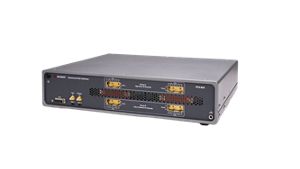
Interconnect and Network Performance Tester
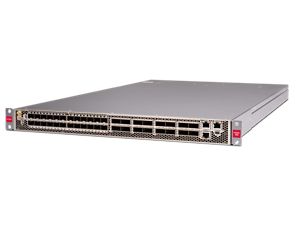
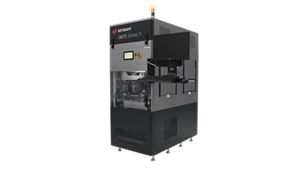
Keysight interconnect and network performance testers deliver ultra-high-speed traffic generation for validating the bandwidth, latency, and stability of copper and optical interconnects in AI clusters and data center networks. Available in 800GE and 1600GE models, these testers emulate realistic traffic profiles and congestion control protocols to characterize the performance of switches, cables, and accelerators in AI / ML environments, with detailed metrics from PHY and link-layer error correction algorithms. With 1.6T support in both benchtop and rack-mount form factors, these systems give network equipment developers and data center operators the insight needed to optimize interconnects for AI workload processing. Need help selecting? Check out the resources below.
Functional Interconnect Test Solutions
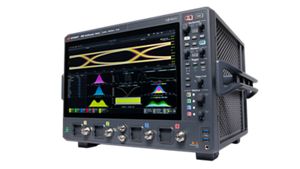
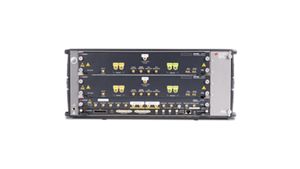
Demand for higher data throughput in AI and data center networks is accelerating the industry’s transition to 800GE and 1.6 Terabit Ethernet (1.6T) network interconnects and beyond. Interfaces operating over 212Gb/s and 106Gb/s electrical lanes are critical to meeting higher reliability targets across network infrastructure. Networks must deliver increased bandwidth and lower cost per Gigabit. Industry standards for 800GE and 1.6T pluggable MSAs define a broad range of high speed fiber and copper interconnect types. Keysight’s multiple lane Functional Interconnect Test Solutions (FITS 8CH) provides 8 Tx and 8 Rx channels of functional BER and Forward Error Correction (FEC) error performance validation.

Meet the Interconnect and Network Performance Tester 1600GE
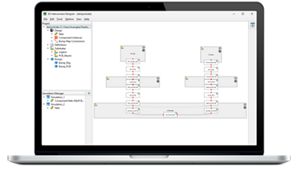
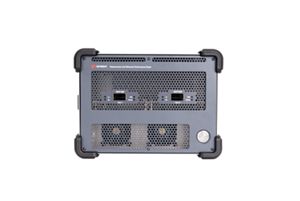
Validate next-generation 1.6T Ethernet interconnects with a high-speed test platform designed for AI data centers. The INPT-1600GE combines advanced traffic generation and analysis with intelligent automation to benchmark silicon, cables, and networking gear across 212 Gb/s electrical lanes. Paired with the Interconnect Test System (ITS) software, it streamlines validation with multi-user scheduling, automated reporting, and a first-of-its-kind interconnect library, accelerating test throughput and reducing time to insight.
Emulate real AI workloads, optimize interconnect performance, and future-proof your infrastructure with a scalable, rackmount or benchtop solution built for the demands of tomorrow’s networks.
Services and support
Innovate at speed with curated support plans and prioritized response and turn-around times.
Get predictable, lease-based subscriptions and full lifecycle management solutions—so you reach your business goals faster.
Experience elevated service as a KeysightCare subscriber to get committed technical response and more.
Ensure your test system performs to specification and meets local and global standards.
Make measurements quickly with in-house, instructor-led training, and eLearning.
Download Keysight software or update your software to the newest version.
Frequently asked questions
Interconnect validation is important for AI data centers because AI training and inference depend on tightly synchronized, high-bandwidth communication between GPUs, switches, and accelerators.
Signal degradation, latency variation, or thermal instability in copper or optical links can slow training jobs or cause workload failures. Keysight enables engineers to validate interconnect reliability and performance under sustained AI workloads, helping ensure that high-speed links operate correctly before deployment in large-scale GPU clusters and AI fabrics.
AI-specific traffic modeling recreates the synchronized, bursty, and latency-sensitive traffic patterns produced by AI workloads.Traditional traffic tests often rely on steady-state packet streams that do not reflect collective operations, high-fanout flows, or accelerator-to-accelerator communication behavior.
This distinction matters because interconnects in AI data centers must be validated under realistic workload conditions to expose congestion points and performance bottlenecks. Keysight supports this type of workload-aware interconnect validation.
An interconnect test solution is selected based on the interface and the validation type required.
Ethernet interconnects typically need system- and network-level validation of bandwidth, latency, and traffic behavior across copper and optical links, which aligns with Keysight’s Interconnect and Network Performance Tester (INPT). Electrical interfaces such as Peripheral Component Interconnect Express (PCIe) often need physical-layer validation, including signal integrity and bit error rate (BER), which aligns with Functional Interconnect Test Solutions (FITS). In 800GE and 1600GE environments, both performance and reliability must be validated for stable operation at scale.
Interconnect tests are validation methods used to measure high‑speed link performance, reliability, and error handling under realistic operating conditions.
Common interconnect tests include signal integrity, compliance, bandwidth, latency, and traffic stability validation. For high‑speed Ethernet links, bit error rate (BER) and forward error correction (FEC) performance are also evaluated. These tests help verify reliable copper and optical interconnect operation in AI and data center networks at 800GE and 1600GE speeds. Keysight provides interconnect and network performance testing for these high‑speed validation requirements.
Interconnect test system specifications determine whether a platform can validate the target data rate, lane architecture, and error performance of next‑generation links.
Key considerations include support for 800GE and 1600GE links, multi‑lane architectures, and detailed physical‑layer (PHY) metrics such as signal integrity, BER, and FEC performance. With leadership in interconnect and network performance testing, Keysight supports validation of these next‑generation link requirements.
Interconnect testing supports the standards and technologies that define performance and validation requirements for modern high‑speed links. This includes 800GE and 1600GE, along with PCIe and cache‑coherent interconnects such as Compute Express Link (CXL).
Validation also covers pluggable interconnect formats across copper and optical environments. These technologies are increasingly important as network and accelerator infrastructures scale to higher speeds while maintaining reliability. Keysight supports validation across these evolving interconnect standards and technologies.
To set up an interconnect test environment for validating high-speed copper and optical links, combine traffic generation, traffic analysis, and error measurement to exercise links under realistic operating conditions.
A typical setup includes ultra-high-speed traffic generation and analysis, along with software for test management, automation, and reporting. This environment supports validation of bandwidth, latency, traffic stability, and link reliability across physical and system levels in AI data center networks. Keysight supports these high-speed interconnect validation workflows.
Common challenges in high-speed interconnect testing include signal loss, crosstalk, noise, and thermal effects, which become more pronounced as link speeds and lane densities increase. These issues can affect signal integrity, BER, FEC performance, and overall link stability across copper and optical interconnects.
Mitigation typically involves validating links under realistic traffic conditions, exercising congestion behavior where applicable, and analyzing detailed physical-layer metrics. Keysight supports validation workflows that help engineers identify and address these challenges in modern high-speed interconnect environments.